
Poomsae
Forms — a fight against an imaginary opponent.
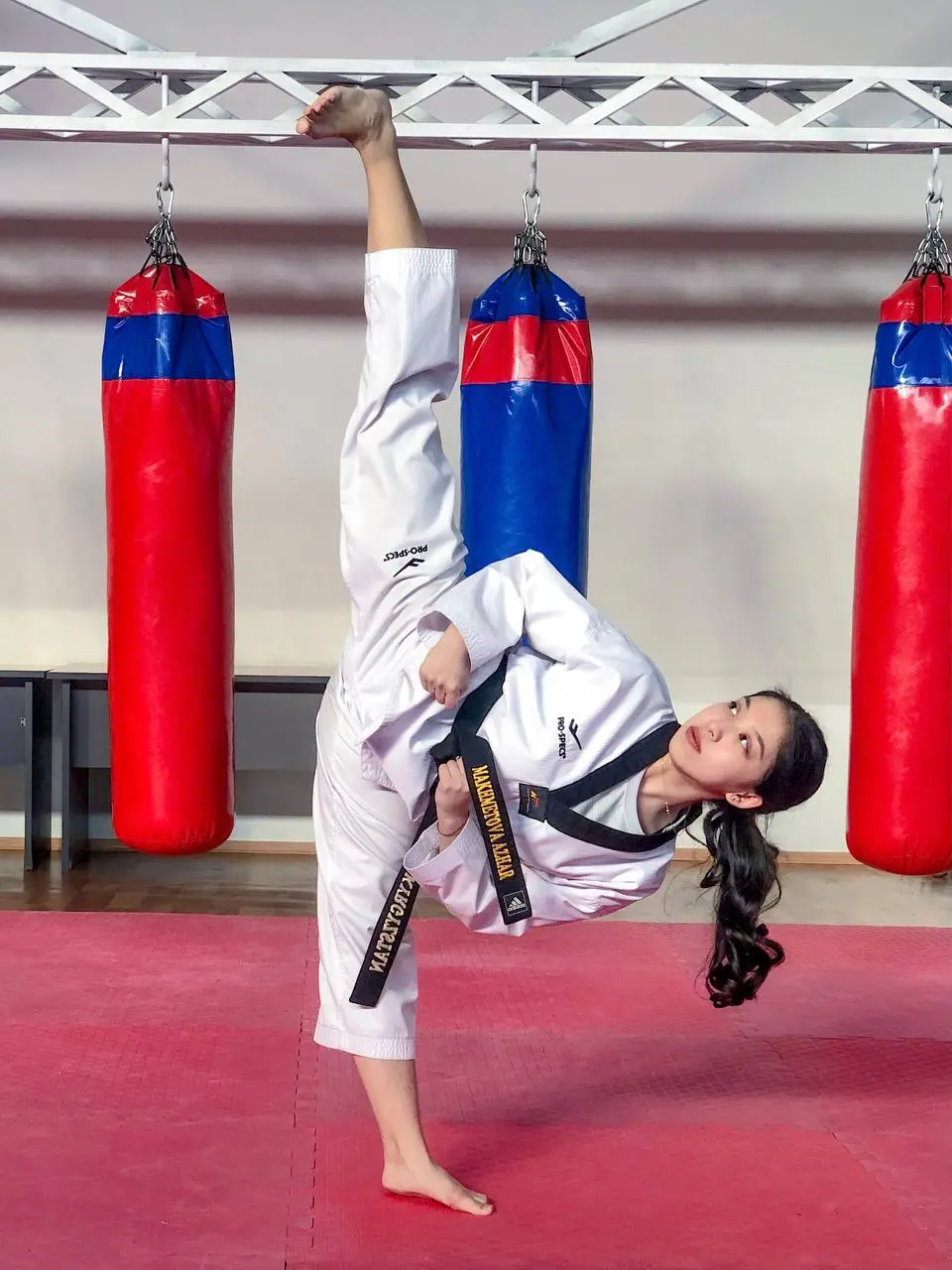
Poomsae is a set of attacking and defensive taekwondo techniques: combinations of hand and foot techniques arranged in a fixed sequence that represent a fight against an imaginary opponent.
The poomsae competition rules apply to individual and synchronised team events held by the Asian Taekwondo Union (ATU) and serve as the basis for meets and competitions in other similar disciplines. To compete, an athlete must hold at least 1st dan in both the individual and the synchronised team programme. A synchronised team has three members, all aged 16 or older.
Competition procedure
In the first round every competitor and every synchronised team performs one compulsory poomsae — the one required to confirm the competitor’s grade. For a synchronised team, the compulsory poomsae is the one required to confirm the grade of its lowest-ranked member.
In the second round every competitor and every synchronised team performs one free-choice poomsae.
In the third and final round every athlete and every synchronised team performs one free-choice poomsae. Each athlete must perform the compulsory poomsae corresponding to his or her dan. The chosen poomsae may be no more than 2 levels above the one required for the competitor’s dan. All poomsae performed must be different.
Scoring
Every poomsae performed is scored on a 10-point scale in tenths of a point. The score should reflect the overall impression of the performance. The judges’ scores are added up by the tournament secretary; the highest and the lowest scores are discarded and the arithmetic mean is calculated from the rest.
If scores are tied in a preliminary or final round, the highest and lowest scores are included when the mean is calculated. If the tie remains, the highest and lowest scores of the previous round are taken into account, and so on. Only when the tie remains after all three rounds is an additional fourth round held.
The athlete or synchronised team with the highest final total wins the competition.